After a delivery app accident in California, the company usually is not treated as the driver’s employer because of Proposition 22, which the California Supreme Court upheld in 2024. But Prop 22 requires delivery companies to carry at least $1 million in auto liability coverage during an active delivery when the car is not otherwise covered. Injured drivers get occupational accident insurance instead of workers’ comp. App status decides who pays.
When a DoorDash or Instacart driver crashes into you, the company whose logo is on the bag has spent years and a statewide ballot measure making sure that the person behind the wheel is not legally its employee. That is the first hard truth about a delivery app accident in California. It shapes every conversation you will have with an insurance adjuster.
The second truth matters more. Not being an employer does not mean nobody pays. California law requires these companies to carry specific insurance, but that coverage only switches on at certain moments, and insurers are counting on you not knowing when.
This article is for two groups in Orange County and Los Angeles. A delivery driver hit the first group, whether in a car, on foot, or on a bike. The second group is the drivers themselves, who got hurt on a delivery and learned they usually have no workers’ comp. Here is a clear map of who pays and what evidence decides it.
Why Delivery App Accidents Are Different From Ordinary Car Crashes
In an ordinary crash, you usually deal with one insurance company: the at-fault driver’s. A delivery app accident can involve several, including the driver’s personal auto policy, the delivery company’s commercial coverage, and occasionally your own policy.
This is because of how app delivery works. The driver uses their car and usually their own insurance. The app, meanwhile, records key moments of each order, including when the driver accepted it and when they completed it.
That record, often called app status, is the thread running through this article. Was the app off, was the driver waiting for an order, or had they accepted a delivery? Each answer points to a different policy, and Uber and Lyft accidents follow a different insurance structure, so rideshare rules do not automatically carry over.
Prop 22 and Why DoorDash and Instacart Say Drivers Aren’t Employees
Proposition 22, approved by California voters in 2020, classifies app-based delivery and rideshare drivers as independent contractors, not employees, as long as the company meets certain conditions. The California Supreme Court upheld Prop 22 in Castellanos v. State of California on July 25, 2024.
An independent contractor works for themselves rather than as an employee. Under Business and Professions Code 7451, a driver keeps that status when the company does not set required hours, does not require accepting particular requests, and allows other apps and other work.
Why does this ruling matter to someone who was hit? Normally, an employer can be responsible for an employee’s careless driving on the job, a rule that lawyers call respondeat superior. Because Prop 22 says app-based drivers are not employees or agents of the company, it creates serious legal obstacles to arguing that the company is automatically responsible as an employer.
That does not end the story. Prop 22 is settled law for now, and it comes with insurance requirements that are often the real path to compensation.
The Insurance Prop 22 Requires (and When It Actually Applies)
Prop 22 requires delivery network companies to carry at least $1 million per occurrence in automobile liability insurance for injuries caused by a driver during engaged time, when the car is not otherwise covered by a compliant auto policy. It also requires occupational accident insurance with at least $1 million in medical coverage for drivers.
Those rules appear in Business and Professions Code 7455. The California Department of Insurance explained them to insurers in a 2021 notice.
Engaged Time Is the Key Phrase
Under Business and Professions Code 7463, engaged time runs from accepting a delivery request until completing it, as recorded in the app. Outside that window, Prop 22 does not require the $1 million company auto policy. The requirement also refers to automobiles, so a crash involving a courier on a bike or scooter may not fall under it.
What DoorDash and Instacart Say They Carry
DoorDash’s Help Center describes third-party auto liability coverage with a $1 million combined limit from accepting a request until the order is marked delivered, unassigned, or canceled. DoorDash says this coverage is secondary to the Dasher’s personal insurance and does not cover the Dasher’s own car or injuries.
Instacart’s California shopper page describes shopper injury protection with up to $1 million in medical expenses. It does not spell out third-party auto terms, so the Prop 22 requirement is the clearest guide.
Here is how coverage generally lines up with app status:
- App off: only the driver’s personal auto policy, which may exclude delivery use
- App on, waiting for an order: the driver’s personal policy, since Prop 22 does not require the company auto policy here
- Order accepted until delivered: at least $1 million in company auto liability if the car is not otherwise covered
The Personal Auto Policy Problem: Business-Use Exclusions
Here is where many claims stall. Personal auto policies commonly exclude commercial use, and delivering for pay can fall into that category. In April 2020, California’s Insurance Commissioner stated that personal auto policies do not typically cover vehicles used for commercial delivery. That notice also offered temporary COVID-era relief linked to the emergency.
Now picture what can happen next. The driver’s insurer denies the claim because the driver was working. The company’s insurer may say its coverage is only secondary, leaving you stuck with medical bills.
This is precisely where people without a lawyer get stuck. The picture changes if the driver carries a delivery endorsement (an add-on to a personal policy) or a commercial policy. Either way, do not accept the first insurer’s “no” as the final word.
If a Delivery Driver Hit You: Building the Claim
If a delivery driver hit you, your claim usually starts against the driver and their auto insurer and then extends to the delivery company’s Prop 22 coverage if the driver was on an active delivery. Prove app status early, because that single fact can decide whether the company’s $1 million coverage is even in play.
Evidence That Proves the Driver Was on a Delivery
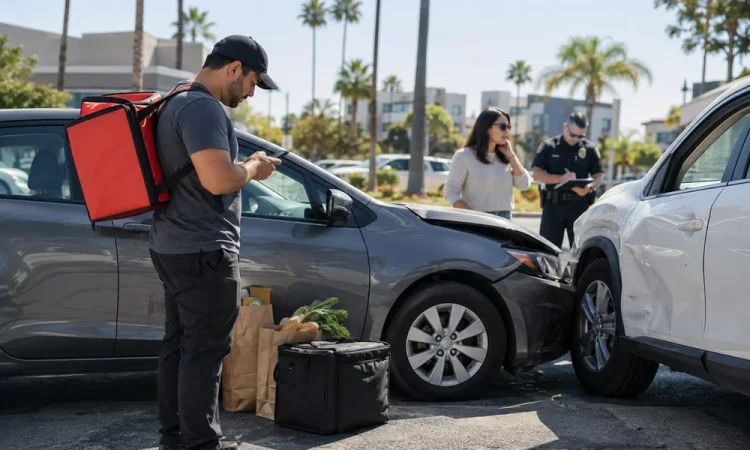
Start at the scene if you can. Photograph insulated delivery bags, food or grocery orders in the car, and any app screen the driver shows. Write down what the driver says, and get witness names.
The police report matters too, whether it comes from the CHP or a city police department. In a lawsuit, you can request app trip logs and GPS data through subpoenas or discovery (the formal process for getting evidence). An early preservation letter asks the company to keep that data, but do not expect it to hand over the data just because you asked.
The At-Fault Driver’s Policy and Your Own Coverage
According to the DMV, California’s minimum liability limits are $30,000 per person, $60,000 per accident, and $15,000 for property damage, effective January 1, 2025, under SB 1107. Those limits are often far less than a serious injury is worth.
Under Insurance Code 11580.2, insurers must offer uninsured motorist (UM) coverage unless you waive it in writing, and underinsured motorist (UIM) protection can help when the other driver’s limits are too low. A hit-and-run can count as uninsured when there was physical contact and a police report within 24 hours. See our guide to uninsured and underinsured motorist coverage.
“The logo on the delivery bag doesn’t pay your bills. The app’s timestamp might.”
Shared Fault, Pedestrians, and Cyclists
California uses pure comparative fault. If you were partly at fault, your recovery is reduced by your share of the blame, not wiped out. The same insurance layers apply if you were walking or riding a bike.
If You’re the Delivery Driver Who Got Hurt
Most app-based delivery drivers in California cannot file a workers’ comp claim because Prop 22 treats them as independent contractors. Instead, delivery companies must provide occupational accident insurance with at least $1 million in medical coverage, plus disability payments. You may also have a claim against the at-fault driver.
Disability payments under Business and Professions Code 7455 equal 66% of your average weekly earnings from all apps in the prior 28 days, for up to 104 weeks. Coverage is not required if you were online but outside engaged time while working on another app or doing personal activities. DoorDash’s occupational accident FAQ says the coverage costs Dashers nothing and that California Dashers have a separate schedule of benefits.
If another driver caused your crash, you can still pursue a claim against that driver. W-2 delivery employees of a restaurant or store are covered by workers’ comp instead, and our guide to workers’ comp and personal injury claims explains how the two can work together.
You generally have two years to file an injury lawsuit under Code of Civil Procedure 335.1. Claims against a government entity generally must be filed within six months.
What Changes When You Have a Lawyer on a Delivery App Accident
A delivery app accident is really an insurance puzzle. The first job is to find every piece: the driver’s policy, the company’s Prop 22 coverage, your UM/UIM, and, for drivers, occupational accident insurance. Then comes the fight over app status.
When two insurers point at each other, someone has to push both of them. There’s no guarantee the company’s policy applies, and if the driver was offline, the case may only involve personal policies. An experienced car accident lawyer can review which coverage fits your facts.
Key Takeaways
- Prop 22 generally makes DoorDash and Instacart drivers independent contractors, not employees.
- Delivery companies must carry at least $1 million in auto liability coverage during engaged time when the car is not otherwise covered.
- Proving the driver had accepted an order can decide which policy pays.
- Injured app-based drivers usually get occupational accident insurance, not workers’ comp.
- California generally allows two years for an injury lawsuit and six months for government claims.
This article is for general information only and is not legal advice. Insurance policies change, every case depends on its specific facts, and no outcome is guaranteed.
Delivery App Accident Claims Come Down to One Moment
The delivery companies built a system where drivers are not employees. The law still requires coverage, and your job is to prove the moment that turns it on. Document app status early, and do not let two insurers pass you back and forth.
Oracle Law Firm helps people hurt in delivery app accidents across Orange County and Los Angeles, with a Spanish-speaking team and no fees unless we win. Been in an accident or hurt on the job? You don’t have to navigate insurance companies alone. Oracle Law Firm fights to get you the compensation, control, and clarity you deserve.
Get a Free Consultation or call 888.597.4099.
Frequently Asked Questions
Is DoorDash liable if a Dasher hits my car in California?
Usually not as an employer, because Prop 22 treats Dashers as independent contractors. However, delivery companies must carry at least $1 million in auto liability coverage during engaged time when the car is not otherwise covered. DoorDash says its policy is secondary to the Dasher’s personal insurance.
What if the delivery driver’s insurance denies the claim because they were delivering?
Personal auto policies often exclude commercial delivery use. If the driver had accepted an order, the company’s Prop 22 coverage may apply, and your own UM/UIM coverage may also help.
Does Instacart have insurance for accidents caused by shoppers?
Prop 22 requires delivery network companies, including Instacart, to carry at least $1 million in auto liability coverage during engaged time when the car is not otherwise covered. Instacart also describes injury protection for California shoppers with up to $1 million in medical expenses.
Can a DoorDash or Instacart driver get workers’ comp in California?
Generally no, if the company meets Prop 22’s conditions. Instead, drivers receive occupational accident insurance with at least $1 million in medical coverage and disability payments for up to 104 weeks.
How long do I have to file a claim after a delivery app accident in California?
In California, you generally have two years from the date of the injury to file a personal injury lawsuit. Claims against a government entity usually must be filed within six months.